

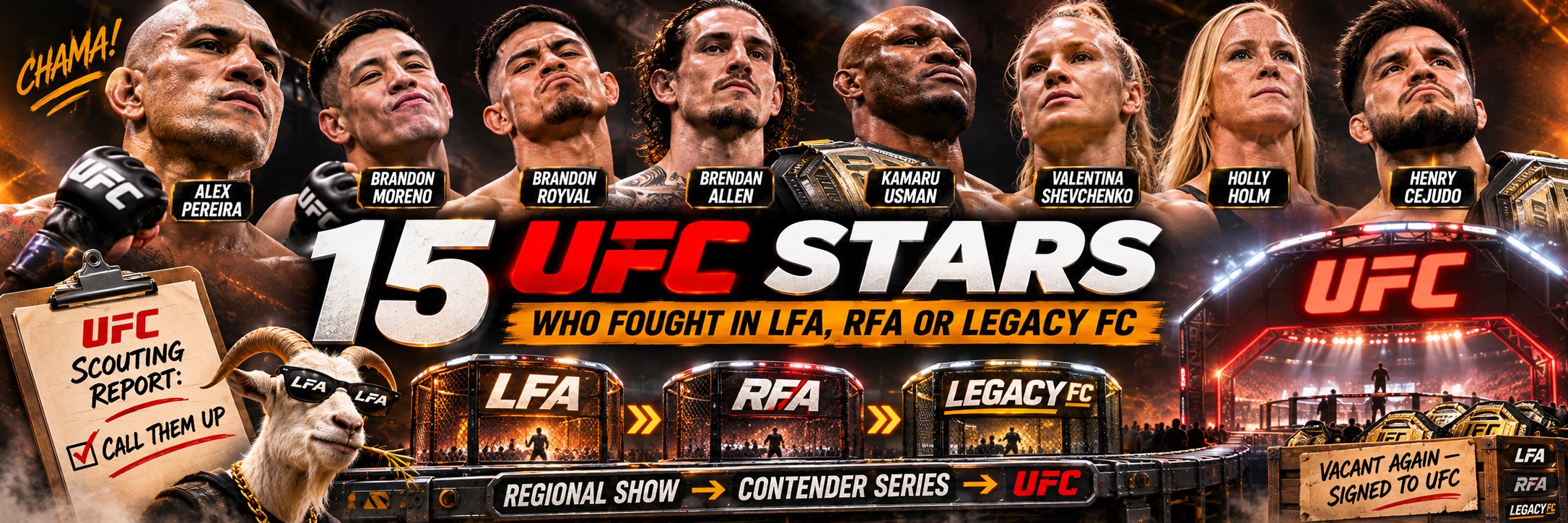
Long before Alex Pereira became a two-division UFC champion, he knocked out Thomas Powell in the main event of LFA 95. Before Sean O'Malley was fighting for UFC bantamweight gold, he was producing spectacular finishes on regional cards, including a spinning hook-kick knockout at LFA 11.
Those two careers offer a glimpse into the history of Legacy Fighting Alliance, one of the most productive developmental organisations in American mixed martial arts.
But LFA's connection to the UFC goes back further than its official launch in 2017. The promotion was created by merging Resurrection Fighting Alliance (RFA) and Legacy Fighting Championship (Legacy FC), two organisations whose alumni included future UFC champions Kamaru Usman, Holly Holm, Valentina Shevchenko and Henry Cejudo.
Not every fighter followed the same route. Some won regional championships before their first UFC contract. Others appeared in LFA for a single fight, returned to the regional circuit after being released, or used the organisation as a bridge between different stages of their professional careers.
These 15 fighters tell some of the most interesting stories from LFA, RFA and Legacy FC history.
To understand the promotion behind these careers, read our complete guide to Legacy Fighting Alliance, covering the merger of RFA and Legacy FC, LFA's championship history and its role in developing future UFC talent.
15 Famous UFC Fighters Who Competed in LFA, RFA or Legacy FC
1. Alex Pereira — LFA 95: Pereira vs. Powell
Alex Pereira's appearance at LFA 95 on November 20, 2020, has become one of the most frequently revisited moments in the organisation's history.
The Brazilian was already an elite kickboxer, having won world titles in Glory, but his professional MMA career was still in its early stages. He entered his LFA debut with a 2-1 MMA record and faced Thomas Powell in the middleweight main event in Park City, Kansas.
Pereira immediately demonstrated the striking ability that had made him successful in kickboxing. He attacked Powell with powerful kicks, knees and measured punches while dealing with attempts to close the distance.
Late in the opening round, Pereira landed a devastating left hook that knocked Powell unconscious. The official finish came at 4:04 of Round 1.
The knockout was particularly striking because Pereira had spent years competing primarily as a kickboxer. His performance suggested that the power and timing developed in Glory could translate effectively to professional MMA.
Pereira subsequently joined the UFC, where he defeated Israel Adesanya to win the middleweight championship in November 2022. He later moved to light heavyweight and won another UFC title.
Unlike many LFA graduates, Pereira did not spend years developing in the promotion. His single appearance was a showcase for a world-class striker making an important transition between combat sports.
That finish is among the performances revisited in MMAtown's LFA knockout compilation featuring Pereira, Sandhagen and Rountree.
2. Sean O'Malley — LFA 11: The David Nuzzo Knockout
Sean O'Malley was an unbeaten bantamweight prospect when he appeared at LFA 11 in Phoenix, Arizona, on May 5, 2017.
Facing David Nuzzo, O'Malley had an opportunity to introduce his unorthodox striking style to a wider audience through the nationally televised event.
He made the most of it.
After creating openings with his punches and movement, O'Malley landed a spinning hook kick that knocked Nuzzo out at 2:15 of the opening round. The highlight quickly attracted attention beyond the immediate regional MMA audience.
The victory improved O'Malley's professional record to 6-0 and helped build the reputation that eventually earned him a place on Dana White's Contender Series.
He appeared on the programme later in 2017, knocking out Alfred Khashakyan to secure a UFC contract.
O'Malley went on to become UFC bantamweight champion in August 2023 by stopping Aljamain Sterling.
His LFA appearance is a useful reminder that some future UFC champions are already displaying their most recognisable attributes long before reaching the biggest stage. The timing, creativity and confidence that defined O'Malley's later career were visible against Nuzzo.
3. Alexandre Pantoja — RFA Champion and the Historic Legacy Superfight
Alexandre Pantoja's connection to the organisations that created LFA is particularly significant because he competed in a joint event that foreshadowed their eventual merger.
The Brazilian flyweight won the RFA championship at RFA 18 in September 2014, submitting Matt Manzanares with a rear-naked choke in the second round.
He subsequently faced Legacy FC champion Damacio Page in the main event of the special RFA vs. Legacy FC superfight on May 8, 2015, in Mississippi.
The matchup brought together champions from two rival regional promotions, creating an opportunity for both organisations to demonstrate the quality of their fighters.
Pantoja trapped Page in a triangle choke late in the second round. Page was rendered unconscious in the hold, and the fight was recorded as a technical submission at the conclusion of Round 2.
The victory strengthened Pantoja's credentials as one of the most promising flyweights competing outside the UFC.
He later participated in The Ultimate Fighter 24 before making his official UFC debut in January 2017.
Years of competing against elite flyweights eventually culminated in Pantoja becoming UFC flyweight champion in July 2023, when he defeated Brandon Moreno.
His career is especially important to LFA's history because the RFA vs. Legacy FC superfight demonstrated the potential of bringing the two talent pools together before they formally merged in 2017.
4. Brandon Moreno — LFA 69 and the Road Back to the UFC
Brandon Moreno's LFA story is unusual because he had already competed in the UFC before arriving in the organisation.
After making his UFC debut in 2016 and recording several important victories, Moreno suffered consecutive defeats and was released in 2018 during a period of uncertainty surrounding the UFC flyweight division.
Rather than abandoning his ambitions, the Mexican fighter signed with LFA and accepted a championship matchup against Maikel Perez.
The fight took place at LFA 69 on June 7, 2019, in Cabazon, California.
Perez brought an Olympic wrestling background into the contest, but Moreno defended effectively against much of his grappling pressure and gradually took control of the striking exchanges.
After hurting Perez in the third round, Moreno increased his attacks and eventually secured a fourth-round TKO to win the LFA flyweight championship.
The result was an important turning point. Moreno returned to the UFC later that year, drawing with Askar Askarov before rebuilding his momentum through victories against established opponents.
In June 2021, he submitted Deiveson Figueiredo to become the UFC's first Mexican-born champion.
Moreno's career demonstrates a different function of the LFA system. Regional MMA is not only about discovering unknown fighters. It can also provide a platform for athletes attempting to rebuild their careers and earn another opportunity.
5. Kamaru Usman — From RFA 5 and Legacy FC to UFC Champion
Kamaru Usman made his professional MMA debut at RFA 5 on November 30, 2012, defeating David Glover by second-round TKO.
At the time, Usman was a former collegiate wrestler beginning the transition into mixed martial arts. His wrestling background gave him a strong foundation, but he still needed experience combining striking, grappling and cage control against professional opposition.
Following his RFA appearance, Usman continued developing on the regional circuit before competing repeatedly for Legacy FC in 2014.
He defeated Steven Rodriguez at Legacy FC 27, Lenny Lovato at Legacy FC 30 and Marcus Hicks at Legacy FC 33, recording stoppage victories in all three contests.
Those performances helped establish Usman as a serious welterweight prospect before his appearance on The Ultimate Fighter 21.
Usman won the competition in 2015 and began building one of the most successful welterweight careers of his generation.
In March 2019, he defeated Tyron Woodley to become UFC welterweight champion. His title reign included successful defences against Colby Covington, Jorge Masvidal and Gilbert Burns.
Usman's career highlights the combined historical contribution of RFA and Legacy FC. He competed in both organisations before their merger, and his later UFC success became part of the broader LFA alumni story.
6. Valentina Shevchenko — Legacy FC 39 Before UFC Flyweight Dominance
Valentina Shevchenko had already developed extensive experience in striking disciplines before making her Legacy Fighting Championship appearance in 2015.
The Kyrgyzstani fighter competed against Jan Finney at Legacy FC 39 on February 27, 2015, in Houston, Texas.
Shevchenko won the bantamweight contest by unanimous decision after three rounds, adding another professional MMA victory to a career that had included long periods of activity in kickboxing and Muay Thai.
Her time with Legacy FC was relatively brief. Unlike younger prospects building experience through numerous regional events, Shevchenko arrived with an established international combat sports background.
She made her UFC debut in December 2015, defeating Sarah Kaufman by split decision.
Over the following years, Shevchenko developed into one of the most technically accomplished fighters in women's MMA, challenging for the bantamweight championship before moving to flyweight.
She won the UFC flyweight title in December 2018 and went on to produce a long championship reign.
Her Legacy FC appearance is an interesting chapter because it connects one of women's MMA's most successful champions to the regional American circuit before she reached international prominence in the UFC.
7. Holly Holm — From Legacy FC Champion to the Ronda Rousey Knockout
Holly Holm's path to the UFC was different from those of most MMA prospects. By the time she competed for Legacy FC, she was already an accomplished professional boxer with multiple world championships.
Holm began developing her MMA career while transitioning away from boxing, competing regularly in New Mexico and other regional markets.
She defeated Allanna Jones by head-kick knockout at Legacy FC 21 in July 2013 and followed it with a second-round TKO against Nikki Knudsen at Legacy FC 24 that October.
Her biggest Legacy FC moment came in April 2014, when she faced Juliana Werner for the inaugural women's bantamweight championship at Legacy FC 30 in Albuquerque.
Holm won by fifth-round TKO, claiming her first professional MMA title after dropping Werner with a head kick and finishing the fight with follow-up punches.
The victory reinforced her status as an emerging contender and helped establish her credentials before joining the UFC in 2015.
Later that year, Holm produced one of the most famous upsets in MMA history when she knocked out Ronda Rousey with a head kick at UFC 193 to become UFC women's bantamweight champion.
For Legacy FC, Holm was an important example of how a highly accomplished athlete from another combat sport could use regional MMA competition to develop the skills and experience needed for the UFC.
8. Henry Cejudo — Olympic Champion at Legacy FC 24
Henry Cejudo entered professional MMA with one of the strongest wrestling backgrounds imaginable.
He won Olympic gold in freestyle wrestling at the 2008 Beijing Games before transitioning into mixed martial arts in 2013.
After beginning his professional career with several early victories, Cejudo signed with Legacy FC and faced Ryan Hollis at Legacy FC 24 on October 11, 2013.
The event took place in Allen, Texas, and also featured Holly Holm on the same card.
Cejudo defeated Hollis by unanimous decision, earning identical 30-27 scorecards from all three judges. The result provided another opportunity to develop his MMA skills beyond the wrestling experience that had already made him an elite athlete.
He subsequently joined the UFC in 2014, initially competing in the flyweight division.
Cejudo achieved his breakthrough in August 2018, defeating Demetrious Johnson to win the UFC flyweight championship. He later moved to bantamweight and captured a second UFC title in June 2019.
His Legacy FC appearance was not the beginning of his fighting career, nor was it the main reason for his athletic success. It was one of the professional MMA contests that helped bridge his transition from Olympic wrestling to championship-level MMA.
9. Derrick Lewis — The Legacy FC Heavyweight Champion
Derrick Lewis was establishing his reputation as a dangerous heavyweight knockout artist long before becoming one of the UFC's most recognisable finishers.
His early professional career included appearances with Legacy Fighting Championship, where he competed against experienced regional opponents.
At Legacy FC 13 on August 17, 2012, Lewis faced undefeated heavyweight prospect Jared Rosholt for the promotion's vacant heavyweight championship.
Rosholt, an accomplished collegiate wrestler, was considered a difficult matchup because of his grappling ability. He controlled portions of the opening round, using takedowns to keep Lewis on the defensive.
Lewis eventually found the opportunity he needed, knocking Rosholt out with punches in the second round to capture the championship.
Fans can revisit the bout through Derrick Lewis vs. Jared Rosholt — the full Legacy FC heavyweight championship fight.
He later defended the title against Ricky Shivers at Legacy FC 18 in March 2013, winning by third-round TKO.
Lewis joined the UFC in 2014 and developed a career built around extraordinary punching power and an ability to produce sudden finishes.
He eventually challenged Daniel Cormier for the UFC heavyweight championship in 2018 and continued to establish himself among the promotion's most successful knockout artists.
Lewis represents an important part of Legacy FC's history: a fighter who developed his professional career in the regional heavyweight division before becoming an established UFC main-event attraction.
10. Brandon Royval — The 23-Second LFA Championship Submission
Brandon Royval spent considerably more time developing in LFA than many of the better-known names on this list.
The Colorado flyweight competed repeatedly for the promotion, gaining experience against a variety of opponents before earning a championship opportunity.
He challenged for the interim LFA flyweight championship at LFA 53 in November 2018, losing to Casey Kenney by unanimous decision.
Rather than leaving the organisation, Royval continued competing and earned another opportunity to claim the championship.
At LFA 79 on November 22, 2019, he faced Nate Williams for the vacant flyweight belt in Broomfield, Colorado.
Royval attacked immediately, using an aggressive sequence of striking and submission attempts to put Williams under pressure. He eventually secured an armbar just 23 seconds into the opening round.
The victory produced the fastest submission in LFA history at the time and earned Royval the flyweight championship.
He made his UFC debut in May 2020, submitting Tim Elliott, and quickly became known for his relentless pace and willingness to attack submissions during chaotic exchanges.
Royval eventually challenged Alexandre Pantoja for the UFC flyweight championship in December 2023.
His progression illustrates the value of remaining active on the regional circuit even after suffering an important championship defeat.
11. Brendan Allen — LFA Middleweight Champion Before UFC Contention
Brendan Allen was already building a reputation as a dangerous grappler when he became a leading contender in LFA's middleweight division.
His opportunity to win the championship came at LFA 50 on September 21, 2018, against undefeated prospect Tim Hiley.
Allen controlled important portions of the contest before finishing Hiley with a rear-naked choke in the third round, claiming the LFA middleweight title.
He subsequently defended the championship against Moses Murrietta at LFA 61 in February 2019. Allen won a clear unanimous decision over five rounds, demonstrating that he could control a title fight without relying entirely on a quick submission.
His regional success led to an opportunity on Dana White's Contender Series in July 2019, where he submitted Aaron Jeffery and earned a UFC contract.
Allen went on to establish himself in the UFC middleweight division, using aggressive grappling, back control and submission skills to earn significant victories.
Unlike a fighter who made one memorable LFA appearance before signing with the UFC, Allen built a substantial championship résumé in the promotion.
His career provides a good example of LFA's intended developmental structure: win meaningful regional fights, establish yourself as a champion and use those performances to attract opportunities at the next level.
12. Joaquin Buckley — From LFA Knockouts to UFC Highlights
Joaquin Buckley arrived in LFA with professional experience from other organisations, including Bellator MMA.
His LFA debut came against Chris Harris at LFA 76 on September 13, 2019. Buckley won by first-round TKO, using his aggressive striking to secure the stoppage.
He returned at LFA 87 in July 2020, facing Jackie Gosh in another middleweight contest.
Buckley once again relied on his physicality and punching power, eventually finishing Gosh by second-round TKO.
The timing of that victory proved crucial. Buckley received an opportunity to make his UFC debut against Kevin Holland on short notice, competing just eight days after his LFA 87 victory.
He lost the fight against Holland, but his UFC career quickly produced one of the sport's most extraordinary knockout highlights.
In October 2020, Buckley knocked out Impa Kasanganay with a jumping spinning back kick, a finish that became a viral sensation.
Buckley's route demonstrates how quickly a fighter's circumstances can change. A regional victory can be followed almost immediately by a UFC opportunity, particularly when the organisation needs a replacement fighter prepared to compete.
His explosive performances in LFA helped ensure he remained visible to matchmakers during a pivotal stage of his career.
13. Mackenzie Dern — From Legacy FC Submissions to the UFC
Mackenzie Dern entered professional MMA with an exceptional Brazilian jiu-jitsu résumé, including multiple world-level grappling achievements.
Her early MMA career included appearances in both Legacy FC and the newly formed LFA.
One of her most memorable performances came at Legacy FC 61 in October 2016, when she faced Montana Stewart, later known as Montana De La Rosa.
Dern used a series of grappling transitions, including an omoplata attack, to create an unusual finishing opportunity. She ultimately submitted Stewart with a rear-naked choke in the opening round.
The sequence attracted attention within the grappling community because of the creativity and technical control involved.
After the RFA and Legacy FC merger, Dern competed at LFA 6 in March 2017 against Katherine Roy.
She won by unanimous decision, improving her professional MMA record to 3-0. The contest was valuable for a different reason from the Stewart submission: it gave Dern a longer fight in which to develop her striking and overall MMA game.
Dern returned at LFA 24 in October 2017 to face Mandy Polk. This time she secured another first-round submission, finishing Polk with a rear-naked choke at 2:55.
That performance is featured in Mackenzie Dern's LFA fight against Mandy Polk.
Dern joined the UFC in 2018 and went on to establish herself as an accomplished strawweight contender with dangerous submission skills.
Her development demonstrates that a world-class specialist still needs professional MMA experience to adapt those skills to a sport that combines striking, wrestling and grappling.
14. Maycee Barber — Four LFA Fights Before the UFC
Maycee Barber developed much of her early professional MMA experience in LFA before becoming one of the UFC's notable young prospects.
She made her professional debut at LFA 14 on June 23, 2017, defeating Itzel Esquivel with a first-round armbar submission.
Barber returned at LFA 22 in September 2017, earning a unanimous-decision victory over Mallory Martin.
Her next appearance came at LFA 33 in February 2018, where she submitted Kaila Thompson with a rear-naked choke just 31 seconds into the opening round.
She then faced Audrey Perkins at LFA 39 in May 2018, winning by third-round TKO.
Those four victories gave Barber a strong start to her professional career and demonstrated an ability to win through submissions, decisions and strikes.
In July 2018, Barber competed on Dana White's Contender Series against Jamie Colleen. She earned a third-round stoppage and secured a UFC contract.
She made her UFC debut later that year, defeating Hannah Cifers by second-round TKO.
Barber's development followed a relatively direct route through the regional system: begin a professional career in LFA, gain experience across several fights, impress UFC matchmakers on Contender Series and move into the world's leading promotion.
15. Geoff Neal — LFA 16 and the Road to UFC Welterweight Contention
Geoff Neal developed his professional career in Texas, building a reputation for powerful striking before reaching the UFC.
His regional record included appearances with several organisations, but one of his most significant victories came at LFA 16 on July 14, 2017.
Facing Bilal Williams in Dallas, Neal imposed his aggressive striking game and secured a first-round TKO with punches late in the round.
The performance added another important victory to his professional record at a time when he was attempting to attract wider attention.
Neal subsequently appeared on Dana White's Contender Series in July 2017, facing Chase Waldon. He won by first-round TKO, earning a UFC contract.
He made his UFC debut in February 2018 and developed into an established welterweight contender, recording notable victories over fighters including Belal Muhammad, Mike Perry and Vicente Luque.
Neal's LFA appearance was part of a relatively short but significant stage in his career. He had already gained experience on the regional circuit, and his performances helped put him in position for a UFC opportunity.
His progression shows another familiar route through American MMA: a promising regional fighter uses televised competition to prove his readiness for stronger international opposition.
Other Notable UFC Fighters From LFA, RFA and Legacy FC
The fifteen fighters above represent only part of the organisations' combined history.
Sean Brady headlined LFA 49 in September 2018, defeating Gilbert Urbina by unanimous decision before joining the UFC and establishing himself in the welterweight division.
Sergio Pettis won the inaugural RFA flyweight championship at RFA 8 in June 2013, knocking out Dillard Pegg in 51 seconds. He later competed in the UFC and became Bellator bantamweight champion.
Kevin Holland also appeared in both Legacy FC and LFA, including a middleweight main event against Curtis Millender at LFA 13 in June 2017.
Other notable alumni include Pedro Munhoz, Cynthia Calvillo, Brian Ortega, Diego Ferreira and several generations of prospects who eventually earned UFC contracts.
These fighters demonstrate the depth of the talent associated with LFA's history. Some became champions, others developed into established UFC contenders, and many had shorter careers at the highest level.
What Is the Difference Between LFA, RFA and Legacy FC?
Although the organisations share a common history, it is important to distinguish them.
RFA and Legacy FC existed as separate promotions before their merger. They held their own events, crowned their own champions and developed independent fighter rosters.
In September 2016, their merger was announced, with Legacy Fighting Alliance officially beginning operations in January 2017.
That means fighters such as Kamaru Usman, Holly Holm, Valentina Shevchenko, Henry Cejudo and Derrick Lewis competed for predecessor organisations rather than LFA itself.
By contrast, fighters including Alex Pereira, Sean O'Malley, Brandon Moreno, Brandon Royval and Brendan Allen appeared under the LFA banner after the merger.
Both groups are part of the promotion's broader historical legacy, but their individual fight records should be credited to the organisations that actually staged those events.
Why LFA Has Produced So Many UFC Fighters
The success of LFA and its predecessors cannot be explained by a single fighter, coach or championship division.
The organisations have consistently offered professional bouts against meaningful opposition, often with television or streaming exposure. Their cards have included young prospects, experienced veterans, regional champions and athletes with backgrounds in wrestling, boxing, kickboxing and Brazilian jiu-jitsu.
That environment provides fighters with opportunities to build their records while demonstrating their skills against opponents who are also attempting to reach higher levels of the sport.
The relationship with Dana White's Contender Series has become particularly important. Many LFA graduates have appeared on the programme before receiving UFC contracts.
Yet the career stories are far from identical. Pereira arrived as an established kickboxing champion. O'Malley produced a spectacular knockout during his early professional development. Moreno used LFA to rebuild after his first UFC departure. Royval recovered from a championship defeat to win the promotion's flyweight belt.
Usman, Holm and Cejudo emerged from the earlier regional structure that eventually became LFA.
For MMA fans interested in fighter development, those differences are what make the history worth studying. A successful regional promotion does not manufacture identical athletes; it gives fighters with different strengths and backgrounds an opportunity to prove themselves.
The Next UFC Star Could Already Be Fighting in LFA
It is impossible to predict which regional prospects will eventually become UFC champions. Many talented fighters never reach that level, and others need several years to develop before becoming competitive against elite international opposition.
That uncertainty is part of the appeal of following LFA.
Fans who watched Sean O'Malley knock out David Nuzzo at LFA 11 saw an early example of the creative striking that would later make him famous. Those who followed Brandon Royval's climb through the flyweight division saw a prospect recover from defeat and become a champion.
And anyone watching Alex Pereira knock out Thomas Powell at LFA 95 witnessed a world-class striker taking an important step toward one of the most remarkable transitions from kickboxing to MMA.
The history of LFA, RFA and Legacy FC suggests that some of tomorrow's most interesting UFC fighters may already be competing in front of much smaller audiences today.