

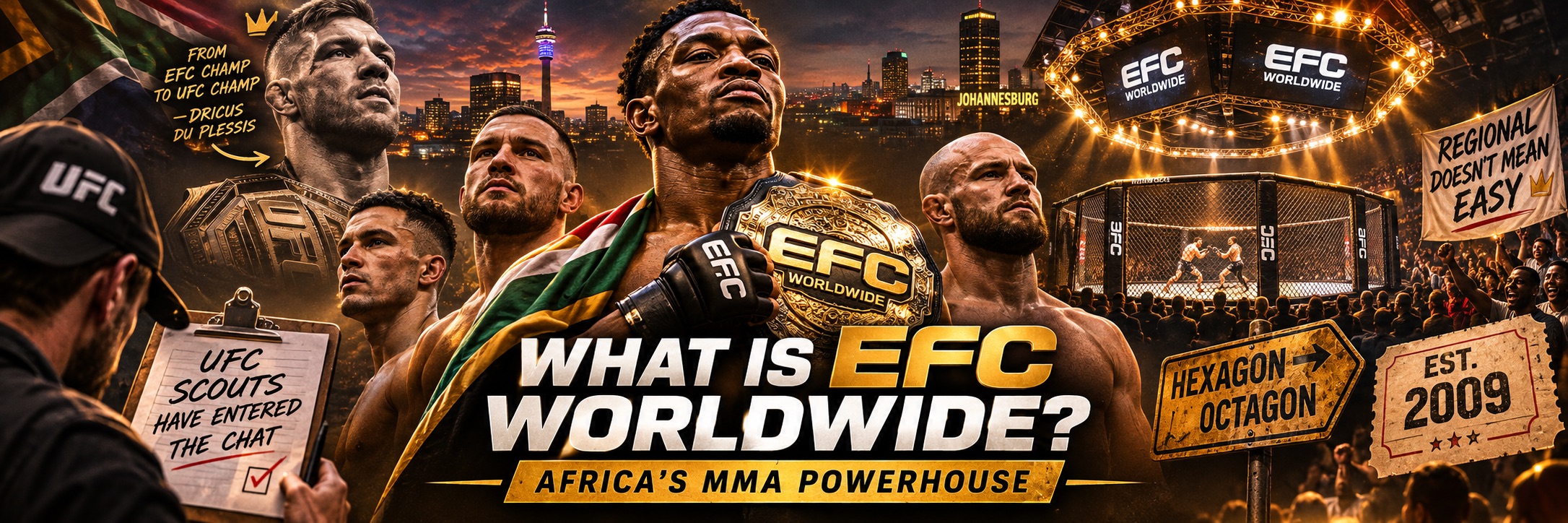
Extreme Fighting Championship, better known as EFC Worldwide, is a South African mixed martial arts promotion based in Johannesburg. Founded in 2009 and originally known as EFC Africa, it has grown into one of the continent's most prominent MMA organisations, staging professional events, crowning regional and international champions, and providing a platform for fighters who would eventually reach the UFC.
Dricus du Plessis, Manon Fiorot, Themba Gorimbo and Don Madge are among its best-known alumni. Their international success has brought attention to a promotion whose history reaches well beyond producing fighters for bigger organisations.
From the early struggles of EFC Africa to championship rivalries, television expansion and worldwide streaming agreements, the Extreme Fighting Championship Worldwide has played a significant role in the development of professional MMA in Africa.
How EFC Africa Began in 2009
EFC's origins go back to a time when South African MMA was still finding its professional footing. There were dedicated fighters, established martial arts gyms and a growing appetite for the sport, but few opportunities for local athletes to compete regularly in professionally organised events with meaningful public exposure.
Brothers Cairo, Calvin and Silas Howarth set out to change that. Working alongside Graeme Cartmell, they developed a promotion intended to bring international-standard MMA events to South Africa while creating opportunities for fighters from across the continent.
The inaugural EFC Africa event took place at Johannesburg's Coca-Cola Dome on November 10, 2009. The organisation introduced its distinctive six-sided fighting enclosure, known as the Hexagon, which would become one of its most recognisable features.
The launch was far from straightforward. In an account published by Fighters Only in 2013, EFC's founders recalled the difficulties surrounding their first show, including problems assembling the Hexagon while spectators were arriving.
The financial challenges were just as substantial. Staging professional MMA events required considerable investment in venues, production, officials and fighter contracts. Ticket sales alone were not enough to guarantee that the business would succeed.
Rather than emerging from an established professional MMA industry, EFC helped develop the commercial environment in which South African fighters could pursue careers without relying entirely on opportunities overseas.
From EFC Africa to EFC Worldwide
Although the promotion initially concentrated on South African athletes, its roster gradually expanded to include competitors from other African nations, including Zimbabwe, Angola, Cameroon, Nigeria and the Democratic Republic of the Congo.
A significant breakthrough came in June 2013, when EFC announced a three-year broadcast agreement with SuperSport. The partnership gave the organisation greater visibility across Africa and provided the kind of television exposure that professional MMA in the region had previously struggled to obtain.
In October 2014, EFC announced that it was opening its roster to fighters from outside Africa. Having previously concentrated on athletes born on the continent or training at African gyms, the promotion began actively seeking international opponents.
The move helped transform EFC from a regional competition into an organisation attracting fighters from Europe and beyond. British, French, Polish and other international athletes would become part of its championship history.
Its increasingly international identity was reflected in the EFC Worldwide name, although Johannesburg and the broader African MMA scene remained central to its operations.
EFC also invested in dedicated facilities, including its Performance Institute in Johannesburg. The venue has hosted numerous events and has become closely associated with the promotion's modern identity.
By December 2022, the organisation had reached EFC 100, a milestone that would have seemed ambitious during its financially uncertain early years.
How EFC Events and Championships Work
EFC operates under professional MMA rules broadly comparable to those used in other major organisations. Fighters compete in weight divisions, with victories awarded through knockouts, technical knockouts, submissions, judges' decisions and other recognised outcomes.
Regular professional bouts are generally scheduled for three five-minute rounds, while championship contests are normally scheduled for five five-minute rounds.
One of the organisation's most distinctive features is the Hexagon. Unlike the UFC's eight-sided Octagon, the EFC enclosure has six sides, giving the promotion a visual identity that has remained consistent since its beginning.
Championships have been contested across divisions ranging from flyweight to heavyweight, alongside women's weight classes. The promotion's title history includes established African champions, overseas challengers and fighters who have won belts in multiple divisions.
Some EFC athletes spend considerable portions of their professional careers competing in the Hexagon. Others make a handful of appearances before pursuing opportunities with organisations such as the UFC, KSW or ONE Championship.
This creates an interesting competitive environment. Established regional champions share cards with younger prospects, returning veterans and international fighters testing themselves against African opposition.
The Fighters Who Put EFC on the International MMA Map
The most recognisable EFC graduate is Dricus du Plessis, who began his professional MMA career in the promotion in 2013.
Du Plessis developed from a promising young fighter into a champion at both welterweight and middleweight. His breakthrough came in August 2017 when he submitted British champion Yannick Bahati at EFC 62, becoming the first athlete in the organisation's history to hold two divisional titles simultaneously.
After also winning the KSW welterweight championship, Du Plessis joined the UFC in 2020. Four years later, he defeated Sean Strickland to capture the UFC middleweight championship, becoming the first South African UFC champion.
His success gave EFC its most prominent connection to the highest level of international MMA, but several other fighters have also made the transition.
French flyweight Manon Fiorot won the promotion's second season of The Fighter before capturing the EFC women's flyweight title against Amanda Lino in December 2019. She subsequently established herself as a leading UFC contender and challenged Valentina Shevchenko for the UFC flyweight championship in 2025.
Gorimbo, who became EFC welterweight champion in 2019, later joined the UFC and developed an international following. Madge became a two-time EFC lightweight champion before making an impressive UFC debut with a knockout of Te Edwards.
Other notable EFC graduates include Cameron Saaiman, Dalcha Lungiambula, Garreth McLellan, Danny Henry and Ruan Potts.
Their careers illustrate different routes through the sport. Some became UFC contenders, while others had comparatively brief runs at the highest level. All competed in an organisation that offered professional opportunities outside MMA's traditional American and European centres.
For a closer look at the fighters who took that next step, explore our 10 EFC Worldwide fighters who made it to the UFC, including their championship achievements, memorable fights and journeys beyond the Hexagon.
The Biggest Fights and Defining Moments in EFC History
Garreth McLellan vs. Dricus du Plessis — EFC 33
Before Du Plessis became a UFC champion, he suffered an important defeat against one of EFC's established middleweights.
At EFC Africa 33 in Durban on August 30, 2014, the 20-year-old challenger faced experienced middleweight champion Garreth McLellan.
Du Plessis entered the fight unbeaten as a professional, but McLellan's experience proved decisive. The champion submitted him with a guillotine choke in the third round, successfully defending his belt.
Looking back at the McLellan vs. Du Plessis fight is particularly interesting because both men would eventually compete in the UFC, although their careers followed very different paths.
Dricus du Plessis vs. Yannick Bahati — EFC 62
Few rivalries in EFC history have generated as much attention as the champion-versus-champion confrontation between Du Plessis and Bahati.
At the time, Du Plessis held the welterweight championship, while Bahati was the reigning middleweight champion. Their matchup at EFC 62 in August 2017 offered Du Plessis an opportunity to make promotional history.
The buildup turned hostile when Bahati slapped Du Plessis during a press conference, creating one of EFC's most memorable confrontations.
When the fighters finally met at Carnival City on August 19, the contest was brief. Du Plessis secured a guillotine choke after just 90 seconds, becoming EFC's first simultaneous two-division champion.
The Du Plessis vs. Bahati result remains one of the most significant in the promotion's championship history.
The rivalry is also featured in EFC's most heated staredowns, which revisits the confrontation alongside other tense moments from the promotion's events.
Amanda Lino Becomes EFC's First Women's Champion — EFC 60
Women's MMA reached an important milestone in June 2017 when Amanda Lino faced Jacqui Trosee for the inaugural EFC women's flyweight championship.
The contest headlined EFC 60 in Durban. Lino imposed her aggressive style, using striking, takedowns and top pressure to control the fight before finishing Trosee with an armbar in the second round.
Her victory established EFC's first women's championship lineage and helped create opportunities for female athletes competing in South Africa.
Manon Fiorot vs. Amanda Lino — EFC 83
Two years after Lino's historic title victory, the championship changed hands in one of EFC's most important international matchups.
French striker Manon Fiorot earned a title opportunity after winning The Fighter Season 2. She challenged Lino at EFC 83 in Pretoria on December 14, 2019.
Fiorot used her movement, controlled striking and distance management to neutralise much of Lino's aggression. After five rounds, she earned a unanimous decision and became EFC women's flyweight champion.
The Fiorot vs. Lino championship fight later gained additional significance as Fiorot developed into one of the UFC's leading flyweight contenders.
The same event featured Du Plessis submitting Brendan Lesar in a middleweight championship contest, making EFC 83 particularly memorable in hindsight.
EFC 100 — A Milestone for African MMA
In December 2022, EFC reached its 100th numbered event, more than 13 years after its inaugural show.
The milestone demonstrated the organisation's longevity in an industry where regional promotions frequently struggle to survive. It also provided an opportunity to reflect on the championship rivalries, developing talent and international broadcasts that had shaped EFC's history.
Reaching triple figures carried significance beyond a single fight card. The promotion had survived its difficult early years and become an established part of the African sporting landscape.
Why EFC Matters to African MMA
EFC's importance extends beyond its relationship with the UFC.
Professional MMA requires far more than talented athletes. Fighters need suitable opponents, experienced coaches, reliable event organisation, championships worth pursuing and opportunities to gain exposure. In countries without established professional fighting infrastructure, those conditions can be difficult to find.
EFC helped create a competitive environment that brought athletes from different African countries into the same professional organisation.
The promotion's 2019 welterweight Grand Prix offers a good example. Zimbabwean fighter Themba Gorimbo competed in a tournament featuring several leading contenders, eventually reaching the final against South Africa's Luke Michael.
At EFC 82 in September 2019, Gorimbo stopped Michael with strikes in the opening round to win the vacant welterweight championship.
The Gorimbo vs. Michael title fight was an important moment for Zimbabwean MMA. On the same card, Cameroon's Simon Biyong claimed the light heavyweight championship, giving the event broader significance across the continent.
These achievements matter independently of what happened later in the fighters' careers. Regional champions can establish substantial reputations and develop dedicated followings without ever moving to the UFC.
EFC has also helped sustain long-running domestic rivalries. Don Madge's battles with Leon Mynhardt, for example, were part of the promotion's early lightweight history.
Madge eventually regained the championship at EFC 58 in April 2017, submitting American titleholder Dave Mazany with a rear-naked choke in the second round.
Established regional fighters, local rivalries and recognisable championships remain essential to the promotion's identity, even as its international audience continues to grow.
How Big Is EFC Worldwide?
EFC's audience has expanded considerably since its early events in Johannesburg.
Its original SuperSport partnership was an important step in establishing television coverage across Africa. Subsequent international distribution arrangements helped introduce the promotion to viewers outside the continent.
In June 2026, DAZN announced a multi-year agreement to distribute EFC events free-to-view in eligible international markets, excluding sub-Saharan Africa and Poland. The agreement began with EFC 134 and represented another major development in the promotion's broadcasting history.
Digital distribution has also become a significant part of EFC's growth strategy. In 2025, the organisation reported that its social media channels had generated more than 400 million video views in a 90-day period.
The figure, discussed in MMAtown's coverage of EFC's reported 400-million-view milestone, represents the promotion's own social media metrics. It should not be confused with unique viewers, television ratings or independently verified live event audiences.
Nevertheless, EFC's growing digital presence demonstrates how a regional MMA promotion can reach an international audience through fight highlights, knockouts, submissions and other short-form content.
Is EFC Worldwide Connected to the UFC?
EFC and the UFC are separate mixed martial arts organisations. EFC is not owned by the UFC and does not operate as an official UFC developmental league.
The connection between them comes primarily through athletes who have competed in both promotions.
Former EFC champions have joined the UFC after building their professional records in South Africa, sometimes progressing through additional organisations or Dana White's Contender Series along the way.
Du Plessis became a UFC champion after holding two EFC titles, while Fiorot reached a UFC championship contest after winning EFC gold. Other former EFC champions, including Gorimbo, Madge and Saaiman, also earned UFC contracts.
However, describing EFC exclusively as a UFC feeder promotion overlooks its own competitive history. The organisation has independent championships, long-running rivalries, established regional fighters and an audience interested in African MMA beyond the careers of future UFC stars.
Where Can You Watch EFC Worldwide?
EFC is available through different broadcasters and streaming services depending on the viewer's location.
Under the international agreement announced in June 2026, DAZN provides free-to-view event coverage in eligible territories outside sub-Saharan Africa and Poland.
In South Africa and other parts of Africa, SuperSport and SABC platforms are among the promotion's broadcast partners. EFC also lists additional distribution partners for selected countries and regions.
Preliminary fights and main-card broadcasts may be distributed separately. Because broadcasting rights and schedules can change, viewers should check EFC's official event information for the latest regional availability.
Frequently Asked Questions About EFC Worldwide
What does EFC stand for in MMA?
EFC stands for Extreme Fighting Championship. The South African organisation was originally known as EFC Africa and is now widely referred to as EFC Worldwide.
When was EFC Worldwide founded?
EFC was founded in 2009 and held its inaugural event in Johannesburg, South Africa, on November 10 of that year.
Where is EFC Worldwide based?
EFC is headquartered in Johannesburg, South Africa. It has also staged events in cities including Durban, Cape Town and Pretoria.
Is EFC part of the UFC?
No. EFC is an independent MMA promotion. Several of its former champions and competitors have subsequently signed contracts with the UFC.
Which famous UFC fighters competed in EFC?
Notable EFC alumni include Dricus du Plessis, Manon Fiorot, Themba Gorimbo, Don Madge, Cameron Saaiman, Dalcha Lungiambula and Garreth McLellan.
Does EFC have world champions?
Yes. EFC awards championship titles across professional MMA weight divisions. These titles are recognised within the organisation and are separate from UFC championships.
What is the difference between EFC Africa and EFC Worldwide?
EFC Africa was the promotion's original identity when it focused primarily on African fighters. EFC Worldwide reflects its expansion into international matchups and audiences.
EFC's Place in the Global MMA Landscape
EFC is not the largest MMA promotion in the world, but it occupies an important place in the sport's development.
It established a professional platform in South Africa, provided opportunities for athletes from across the continent and demonstrated that African MMA could produce fighters capable of competing against elite international opposition.
The success of Du Plessis and Fiorot has brought wider recognition to the organisation, but EFC's history includes far more than its famous graduates. It includes the early champions who helped establish the competition, the rivalries that built its audience and the regional fighters whose careers have unfolded inside the Hexagon.
That combination of African identity, professional competition and international opportunity is what makes EFC Worldwide a distinctive part of the MMA landscape.