

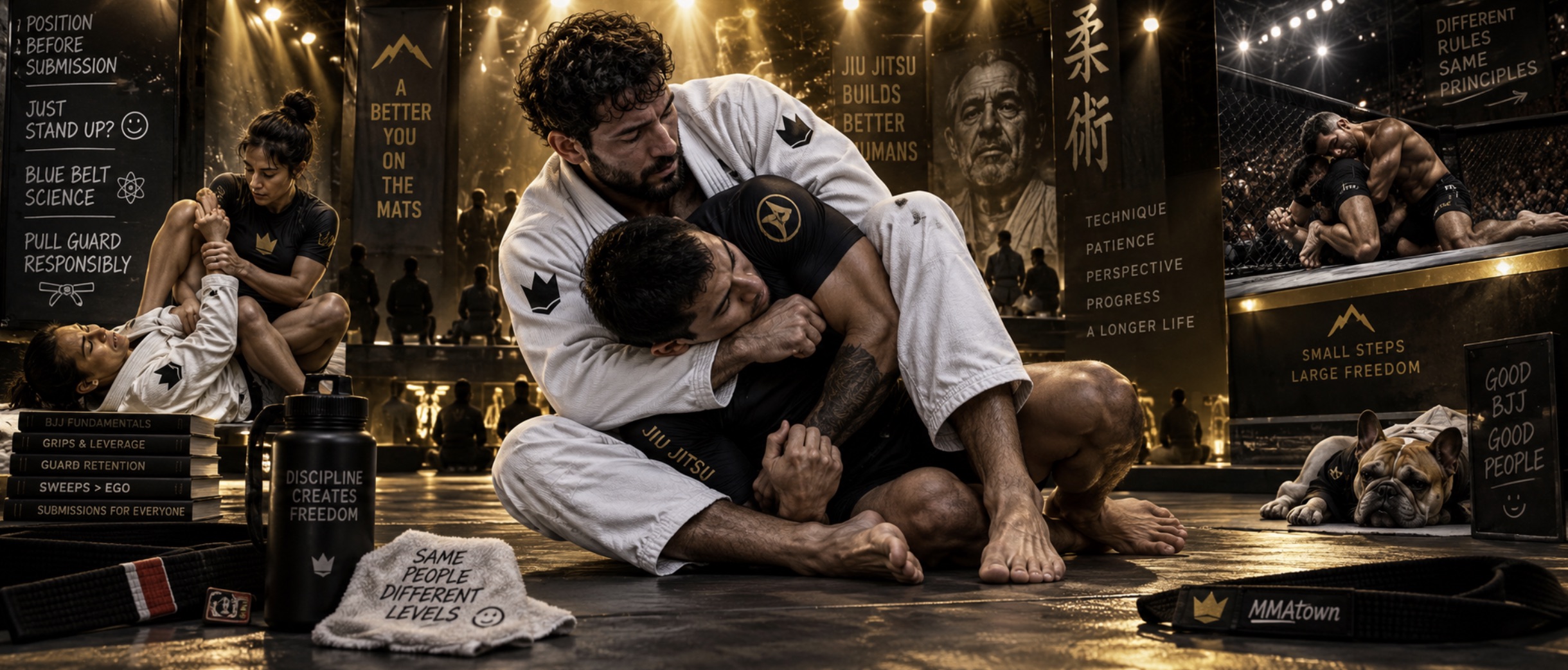
Brazilian Jiu-Jitsu can look almost indecipherable the first time you watch it. Two people spend a minute fighting over a sleeve or changing the position of one leg, very little appears to happen, and then one mistake suddenly becomes a sweep, a back take and a choke.
Once the basic logic clicks, BJJ becomes much easier to follow. Almost everything revolves around a few questions: Who has the better position? Who is controlling the distance? Can the person underneath escape or reverse the position? And is either grappler close enough to threaten a submission?
Brazilian Jiu-Jitsu, usually shortened to BJJ, has grown far beyond the academy mat. It is a major competitive sport in its own right, a fundamental part of modern MMA, and the technical base behind some of the best submission fighters to compete in organizations such as the UFC and ONE Championship.
For somebody starting from zero, however, BJJ comes with its own vocabulary: gi, no-gi, guard, passing, mount, sweep, hooks, frames, rashguards, belt ranks and submissions. This guide puts those pieces together without assuming you already train.
What is Brazilian Jiu-Jitsu?
Brazilian Jiu-Jitsu is a grappling martial art focused on controlling an opponent and eventually forcing a submission through a choke or joint lock. Its modern development took place in Brazil from earlier judo and jujutsu traditions, before BJJ grew into a distinct martial art with its own competition culture and technical systems.
There is no striking in a standard BJJ match. Instead, competitors use takedowns, guard work, sweeps, positional control, guard passing and submissions.
One of the ideas most closely associated with jiu-jitsu is using leverage and technique to deal with a physically stronger opponent. That should not be confused with pretending size and athleticism do not matter. They absolutely do. What BJJ provides is a technical framework for reducing those advantages through positioning, balance, frames and leverage.
Gi vs no-gi BJJ: what is the difference?
Modern Brazilian Jiu-Jitsu is broadly divided into gi and no-gi training.
Gi BJJ is practiced in the traditional jacket and pants commonly called a gi or kimono. The uniform is part of the sport rather than simply something competitors wear. Grapplers can grip the sleeves, lapels and pants to control posture, slow movement, pass guard, sweep and attack submissions.
No-gi removes those fabric grips. Competitors normally wear a rashguard with grappling shorts or compression gear, and control becomes more dependent on underhooks, overhooks, wrist control, body locks, head position and direct grips on the opponent.
The fundamental grappling concepts overlap heavily, but the feel can be very different. Gi matches can become more deliberate because the fabric gives an opponent several ways to slow movement. No-gi generally produces more slippery escapes, wrestling exchanges, leg attacks and fast scrambles.
Is gi or no-gi better for beginners?
Either is a perfectly reasonable place to start.
Gi training exposes a beginner to grip fighting, posture and a huge range of guard systems. No-gi often feels more immediately familiar to somebody coming from wrestling or MMA and forces students to control an opponent without relying on clothing.
Training both is useful because each format can expose weaknesses that the other sometimes hides. A grappler who relies heavily on sleeve and lapel grips has to find different control mechanisms in no-gi. Someone accustomed to escaping through speed and slipperiness may find the gi forces them to become more technically precise.
What should you wear for BJJ?
For a gi class, you will normally need a BJJ gi and the appropriate belt. For no-gi, the standard setup is a close-fitting rashguard with grappling shorts, compression shorts or spats depending on the academy and ruleset.
A rashguard should fit closely enough that loose material does not bunch up or get caught during grappling, but it should not restrict shoulder, hip or torso movement. Good grappling shorts should likewise allow deep squats, guard movement and kicking motions without exposed zippers or hard pieces of material.
If it is your first class, ask the academy before buying anything. Many gyms can lend beginners a gi or tell you exactly what they expect students to wear.
How to choose a BJJ gi
A first BJJ gi does not need to be expensive or complicated. Fit, comfort and durability matter far more than finding the most elaborate model available.
The jacket should give your shoulders enough room to move while not hanging excessively loose. The pants need to allow unrestricted hip movement and squatting. Most brands use sizing such as A0, A1, A2 and A3, but sizing is not completely standardized, so height and weight charts are more useful than assuming the same size fits identically across every manufacturer.
For most people, the useful comparison starts with how the gear will actually be used. Someone training several times per week may prioritize durability and easy washing, while competitors often care more about weight, cut and how much the gi is likely to shrink. Because sizing can vary noticeably between manufacturers, it also helps to compare actual BJJ gi options and size charts before buying rather than assuming an A2 or A3 will fit the same across every brand. No-gi athletes face a similar decision with rashguards: the priority should be a secure fit that stays in place without restricting movement during scrambles.
Fabric weight changes the experience too. A lightweight gi is easier to carry, dries more quickly and can make competition weight management easier. A heavier gi may feel more substantial and durable, but it will also become hotter and heavier during long training sessions.
Pearl weave is one of the terms beginners will frequently encounter when shopping for BJJ gis. It refers to the construction of the jacket fabric. For a new student, however, weave terminology is less important than buying something comfortable, properly sized and capable of surviving repeated training and washing.
What makes a BJJ gi competition legal?
Competition organizations can regulate everything from fabric and color to sleeve length, collar dimensions and patch placement.
Under current IBJJF uniform requirements, gis must be made from woven cotton or cotton-like fabric and use a uniform permitted color. White, royal blue and black are currently allowed under the general uniform rules, with matching jacket and pants.
There are also measurements governing sleeve and trouser length, lapel thickness and collar width. Event-specific requirements can be stricter, particularly at major championships, so a gi that is perfectly acceptable at your academy is not automatically guaranteed to pass tournament inspection.
If competition is the goal, checking the current rules before buying is better than finding out at gi inspection that your favorite training uniform cannot be used.
BJJ belt order explained
The standard adult Brazilian Jiu-Jitsu belt progression is:
- White belt
- Blue belt
- Purple belt
- Brown belt
- Black belt
There are advanced degrees beyond black belt, but those five ranks cover the normal adult progression most students encounter.
White belt is largely about learning how to survive and understanding where you are supposed to be. Escapes, posture and basic positional awareness matter more than developing a collection of exotic submissions.
At blue belt, practitioners normally begin linking positions and techniques together. By purple belt, many people have developed a recognizable personal game: perhaps pressure passing, half guard, wrestling, leg attacks or back control. Brown belt is heavily about refinement, while black belt represents a very high level of technical understanding rather than an end point.
There is no universal countdown that automatically awards somebody the next belt. Promotions depend on the instructor, academy, technical development, consistency and other factors. Competition bodies may impose minimum periods at certain ranks, but completing a minimum period does not automatically mean promotion.
How does BJJ scoring work?
A submission ends a Brazilian Jiu-Jitsu match immediately. If neither competitor submits before the clock expires, traditional tournament rules normally determine the winner using points.
Under the commonly used IBJJF scoring structure:
- Takedown: 2 points
- Sweep: 2 points
- Knee on belly: 2 points
- Guard pass: 3 points
- Mount: 4 points
- Back control: 4 points
The position generally has to be established and controlled rather than touched for an instant.
Advantages can also become important. They reward situations in which a grappler comes close to completing a scoring position or legitimate submission without fully finishing it. Penalties may also influence tightly contested matches.
Not every grappling event follows IBJJF scoring. Some competitions use modified points, while submission-only formats deliberately remove conventional point scoring altogether.
The main positions in Brazilian Jiu-Jitsu
You do not need to understand hundreds of named guards to follow a BJJ match. Most grappling exchanges eventually connect back to a relatively small number of major positions.
Guard
Guard is the broad term for positions where the bottom grappler uses the legs to control, obstruct or attack the athlete on top.
Closed guard locks both legs around the opponent. Open guard keeps the legs active without closing around the waist. Half guard traps one of the top athlete's legs. From there, BJJ contains numerous specialized guards such as butterfly guard, De La Riva, spider guard and many others.
The bottom athlete can use guard to sweep to the top, attack a submission or create enough space to escape.
Side control
Side control usually occurs after the top grappler gets beyond the opponent's legs and controls them chest-to-chest from the side.
It provides heavy control while opening routes to mount, the back, arm locks and chokes.
Mount
Mount places one grappler on top of the opponent's torso with the legs controlling from either side. It is one of BJJ's strongest positions because the bottom athlete must carry the top person's weight while simultaneously defending submissions.
Back control
Taking an opponent's back places the attacking grappler behind them, normally using the legs and upper body to maintain control.
It is particularly dangerous because the defender has difficulty seeing attacks while the neck is exposed. The rear-naked choke is the classic finish from this position and one of the techniques that transfers most directly from BJJ into MMA.
Common Brazilian Jiu-Jitsu submissions
BJJ submissions are mainly divided between chokes and joint locks.
Common techniques include:
- Rear-naked choke
- Triangle choke
- Guillotine choke
- Arm-triangle choke
- Armbar
- Kimura
- Americana
- Heel hook
- Kneebar
- Toe hold
Not every technique is legal in every division. Rules differ according to competition, belt level and age. Heel hooks are a particularly good example: they are central to modern elite no-gi grappling but remain restricted in many divisions and rulesets.
That is also why submissions should be learned in a controlled academy rather than copied from a video and tried on somebody at home. The effectiveness of a joint lock comes from its ability to damage the joint, and the gap between pressure and injury can be small.
Why Brazilian Jiu-Jitsu is still essential in MMA
The earliest years of modern MMA showed how badly a fighter could struggle when they had little understanding of submissions or ground positioning. The sport has changed enormously since then. At elite level, everyone has to know how to defend takedowns, escape submissions and survive underneath a competent grappler.
But BJJ is still more than a defensive requirement. For specialists, it can remain the entire foundation of an offensive MMA game.
Charles Oliveira and the UFC submission record
Charles Oliveira is the clearest modern example.
Oliveira has recorded more submission victories than any fighter in UFC history. His finishes have come through rear-naked chokes, guillotines, anaconda chokes, an armbar, a triangle and even a calf slicer, demonstrating how a deep submission game can remain dangerous even against opponents who have spent their entire careers preparing for elite grappling.
What makes Oliveira particularly useful for understanding BJJ in MMA is that his grappling does not exist separately from his striking. He uses pressure, knees and punches to force chaotic reactions, then attacks the neck or back when opponents scramble. Modern MMA jiu-jitsu is often about creating submission opportunities rather than simply taking someone down and calmly working through a traditional sequence.
Mackenzie Dern: elite sport BJJ adapted to MMA
Mackenzie Dern took almost the opposite route.
Dern was an elite professional BJJ competitor before becoming a major MMA fighter. She started training jiu-jitsu as a child and won major black-belt titles, including the IBJJF World Championship and ADCC.
Her transition illustrates both the strengths and limitations of pure BJJ credentials in MMA. Once punches, cage wrestling and takedown entries are added, getting a fight into the right grappling position can be just as important as knowing what to do after it reaches the mat.
Demian Maia built an MMA game around simple, repeatable jiu-jitsu
Demian Maia remains one of the best examples of adapting elite Brazilian Jiu-Jitsu specifically for MMA.
Maia entered MMA with an enormous grappling résumé that included an ADCC championship. Yet some of his most effective UFC performances were notable for how little unnecessary complexity they contained.
Get the opponent down. Control the hips. Take the back. Choke.
Against elite fighters who knew exactly what he wanted to do, Maia repeatedly found ways to reach those same positions anyway. His career became a demonstration that sophisticated grappling does not always need to look complicated.
Gilbert Burns carried world-class BJJ while developing the rest of his MMA game
Gilbert Burns entered MMA after becoming a multiple-time world champion in jiu-jitsu.
Rather than depending entirely on submissions, Burns developed powerful striking and enough wrestling to compete with elite welterweights while retaining the grappling threat underneath everything else.
That is another common path for high-level BJJ athletes entering MMA. Once opponents know that exchanging grappling positions is dangerous, the threat itself can change how they defend on the feet.
Nate Diaz and the gi roots behind an MMA career
Nate Diaz is closely associated with boxing-heavy MMA fights, marathon cardio and the Stockton style that he and his brother Nick made famous, but jiu-jitsu has always been central to his career.
Diaz has described his earliest entry into serious training as beginning when Nick encouraged him to come to the gym and effectively handed him gi pants. He later spent years training Brazilian Jiu-Jitsu alongside the rest of the Cesar Gracie team and has also spoken about training with elite grapplers such as Kron Gracie.
It is a useful reminder that an MMA fighter does not have to compete wearing a gi for gi training to influence their game. Balance, guard awareness, back control, escapes and submission mechanics survive even after sleeve and lapel grips disappear.
Do MMA fighters still train BJJ in the gi?
Some do, although MMA-specific training naturally shifts heavily toward no-gi grappling.
An MMA fighter cannot grab a sleeve or collar inside the cage, so fight camps need wrestling, wall work and grappling systems that function without clothing grips. That does not make gi training useless.
The gi can slow exchanges down and force a practitioner to solve positional problems rather than simply slipping free. For many fighters, it remains one part of broader technical development even if no-gi becomes the priority as a fight approaches.
BJJ outside the UFC: Kade and Tye Ruotolo
Brazilian Jiu-Jitsu no longer needs MMA to provide elite grapplers with a major international stage.
ONE Championship has regularly featured submission grappling alongside MMA, Muay Thai and kickboxing, helping athletes such as Kade Ruotolo and Tye Ruotolo reach audiences far outside conventional BJJ tournaments.
Kade became the inaugural ONE Lightweight Submission Grappling World Champion and also became the youngest ADCC World Champion. Tye later captured ONE's inaugural welterweight submission grappling championship.
The Ruotolo brothers are useful examples of how different modern elite no-gi grappling can look from the stereotype of slow ground fighting. Their matches involve wrestling, relentless passing, scrambles, leg attacks and rapid transitions between submission threats.
Kade has also carried that grappling base into MMA, illustrating the connection between the professional submission-grappling world and the broader combat-sports scene.
What happens in your first BJJ class?
Most first classes are much less intimidating than they look from outside the gym.
A typical session begins with some form of warm-up before the instructor teaches a position or technique. Students pair up and drill the movement with controlled resistance. Depending on the academy, the class may finish with positional sparring or live rounds, commonly called rolling.
Nobody expects a first-day student to understand what they are doing.
In fact, one of the biggest early lessons is becoming comfortable while somebody else is controlling you. New students often burn through their energy trying to escape every position at maximum strength. Learning when to relax, frame and move deliberately is part of the process.
BJJ hygiene and basic training etiquette
Brazilian Jiu-Jitsu involves prolonged skin contact, shared mats and training partners repeatedly using the same equipment, so hygiene matters.
Arrive in clean training gear. Keep fingernails and toenails trimmed. Wash your gi and rashguard after training rather than reusing sweaty equipment. Shower as soon as reasonably possible after class.
Do not train with an obvious contagious skin condition, and tell the academy if you suspect one.
During sparring, tap when a submission is secured rather than waiting until something hurts badly. Likewise, apply submissions gradually enough to give your training partner a chance to tap. Winning a Tuesday-night gym round is not worth injuring somebody.
Is Brazilian Jiu-Jitsu good for self-defense?
BJJ teaches practical skills for situations involving grabbing, clinching or being taken to the ground. Escaping mount, controlling someone from the top, understanding chokes and staying composed underneath another person can all be useful.
Sport jiu-jitsu and real-world self-defense are still different problems.
A hard floor changes the consequences of voluntarily playing guard. Multiple attackers make prolonged ground fighting extremely dangerous. Weapons change the situation completely.
The safest real-world option is usually avoiding the confrontation or leaving rather than trying to prove which martial art works best.
BJJ is therefore better described as a highly effective grappling system with genuine self-defense applications, not a guarantee against every possible physical threat.
Brazilian Jiu-Jitsu FAQ
What does BJJ stand for?
BJJ stands for Brazilian Jiu-Jitsu, a grappling martial art centered on positional control, chokes and joint locks.
What is the BJJ belt order?
The standard adult Brazilian Jiu-Jitsu belt progression is white, blue, purple, brown and black.
How long does it take to get a BJJ black belt?
There is no universal timeline. Reaching black belt normally takes years of consistent training, while promotion standards depend on the instructor and academy. Competition organizations may also impose minimum periods at certain belt ranks.
Should beginners start with gi or no-gi BJJ?
Either is suitable. Gi BJJ introduces fabric grips and tends to emphasize grip fighting, while no-gi relies more heavily on direct body control, wrestling and faster scrambles. Training both provides the broadest foundation.
What should I look for when buying a BJJ gi?
Prioritize fit, freedom of movement, durability and an appropriate fabric weight. If you intend to compete, also check whether the gi complies with the current rules of the tournament organization you plan to enter.
What do you wear for no-gi BJJ?
No-gi practitioners normally wear a fitted rashguard with grappling shorts, compression shorts or spats depending on the academy and competition rules.
What BJJ gi colors are allowed in IBJJF competition?
Current general IBJJF uniform rules permit white, royal blue and black gis, with the jacket and pants matching in color. Athletes should still check current event-specific requirements before competing.
How many points is mount in BJJ?
Under IBJJF-style scoring, an established mount is worth four points.
How many points is a guard pass in BJJ?
A completed guard pass is worth three points under the standard IBJJF scoring system.
Can you win a BJJ match without scoring any points?
Yes. A legal submission ends the match immediately regardless of the score.
What are the most common BJJ submissions?
Common Brazilian Jiu-Jitsu submissions include rear-naked chokes, guillotines, triangle chokes, armbars, kimuras, arm-triangle chokes, heel hooks, kneebars and toe holds. Which techniques are legal depends on the ruleset and competitor level.
Who has the most submission wins in UFC history?
Charles Oliveira holds the UFC record for most submission victories, making him one of the clearest examples of elite Brazilian Jiu-Jitsu successfully adapted to modern MMA.
Was Mackenzie Dern a BJJ champion before MMA?
Yes. Mackenzie Dern was already an elite Brazilian Jiu-Jitsu competitor before her MMA career, winning major black-belt titles including the IBJJF World Championship and ADCC.
Was Demian Maia an ADCC champion?
Yes. Demian Maia won ADCC in 2007 before becoming one of the most successful BJJ specialists of his generation in the UFC.
Do MMA fighters train BJJ in the gi?
Some do. MMA competition itself requires no-gi grappling, but gi training can still develop positional control, balance, guard retention and submission mechanics. Nate Diaz is one prominent MMA fighter whose development was deeply connected to traditional Brazilian Jiu-Jitsu training.
What is the difference between BJJ and submission grappling?
BJJ is a specific martial art and competitive tradition. Submission grappling is a broader category covering grappling formats centered around control and submissions. Modern no-gi Brazilian Jiu-Jitsu and submission grappling overlap heavily, although rules can differ between organizations.
Who are Kade and Tye Ruotolo?
Kade Ruotolo and Tye Ruotolo are elite American submission grapplers who have both won world titles in ONE Championship. Their aggressive no-gi style combines wrestling, passing, scrambles and submission attacks.